
At some point in your renovation journey, someone hands you a document with rows and rows of numbers, unit rates, and terms like "RFT" and "as per site." This is your BOQ, the Bill of Quantities. It looks intimidating on purpose, sometimes literally, because a confusing BOQ is easier to pad.
This guide breaks down exactly how to read one, what each category should cost in India right now, and how to spot the line items where contractors quietly build in their margin.
What a BOQ Actually Is
A BOQ is a detailed, itemized breakdown of every material, quantity, and labor cost involved in your interior project. It is different from a rough estimate, which is usually a single lump sum with no backup, and different from a quotation, which may bundle several line items together without showing you the math.
A proper BOQ shows you three things for every single item: how much of it you're buying, what rate you're paying per unit, and what brand or specification you're getting. If any of those three are missing, you're not looking at a real BOQ. You're looking at a guess with a total at the bottom.
Developers and design firms use BOQs internally to plan procurement. When you ask a contractor or a firm like Livspace or HomeLane for one, you're asking them to show their work. Most first-time buyers never ask, and that's exactly why cost overruns are so common.
Anatomy of a BOQ Line Item
Every line item in a BOQ typically has five columns. Once you know what to look for, the whole document stops feeling like a wall of numbers.
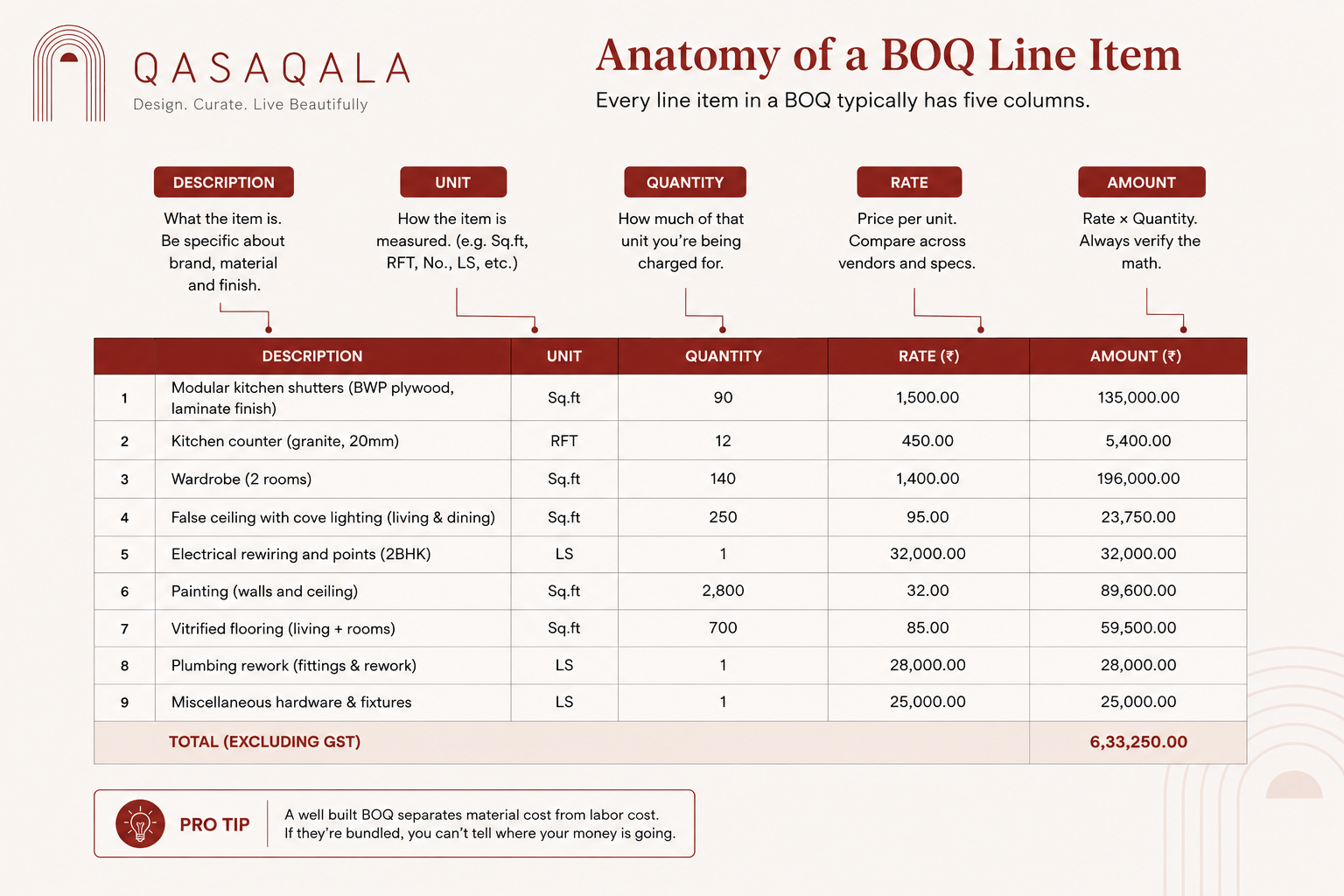
Description: What the item is (e.g., "modular kitchen base unit, plywood carcass, laminate finish").
Unit: How it's measured. This is where a lot of confusion happens. Common units include:
- Sq.ft (square feet) for flooring, false ceiling, wall paneling
- R.ft or RFT (running feet) for wardrobe shutters, kitchen counters, skirting
- CFT (cubic feet) sometimes used for timber quantity
- No. or Nos. for fixtures like switches, lights, hardware
- Lump sum (LS) for items priced as a whole, like electrical wiring for a room
Quantity: How much of that unit you're being charged for. This is the number worth double checking. It's easy to overstate a running foot measurement if nobody's watching.
Rate: The price per unit. This is where budget, mid, and premium tiers diverge the most.
Amount: Rate multiplied by quantity. Always verify this math yourself. Errors here are rarely in your favor.
A well built BOQ separates material cost from labor cost as two different rates rather than bundling them into one number.
When they're bundled, you can't tell if you're overpaying for material, overpaying for labor, or both.
What It Should Actually Cost: Category by Category
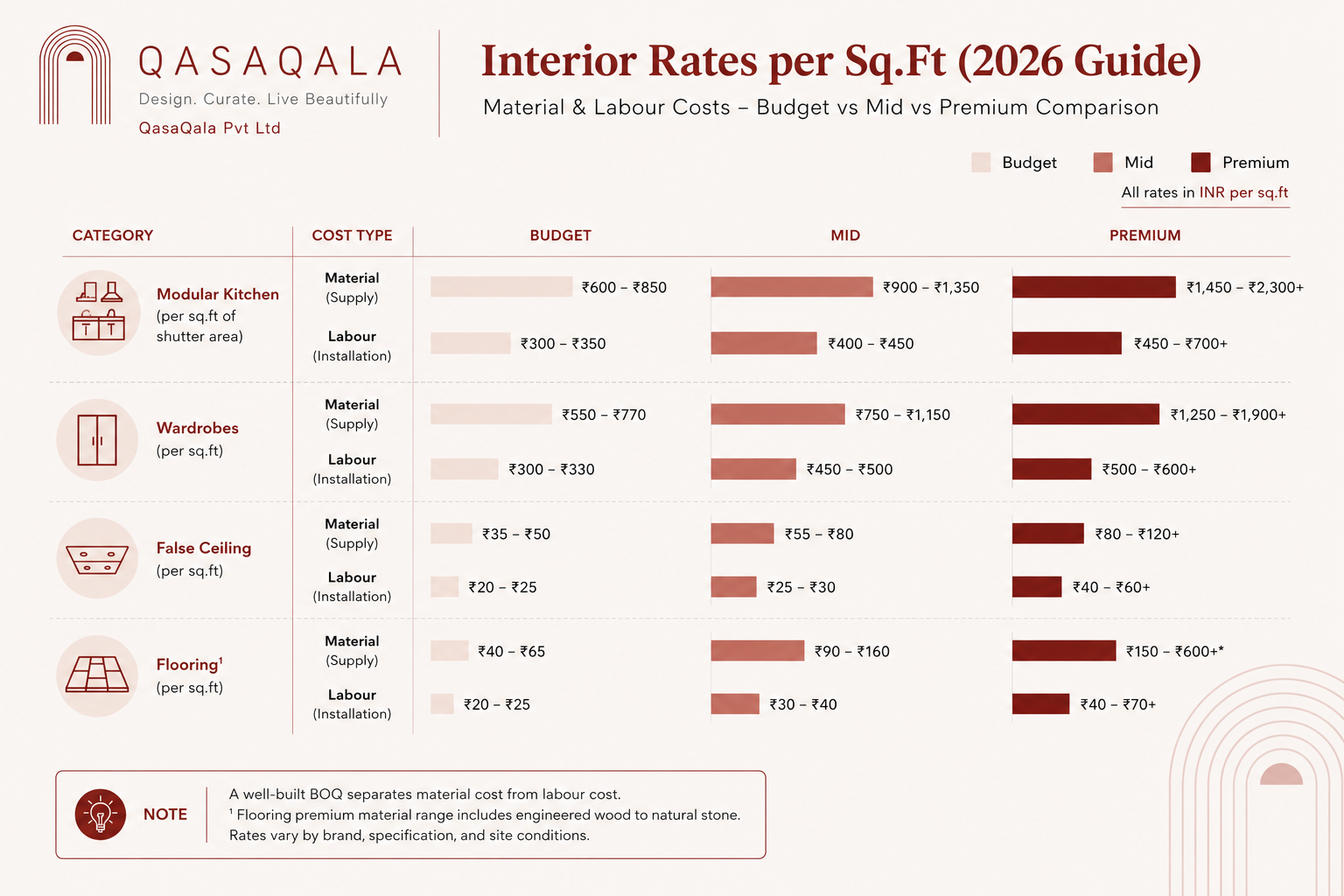
These are realistic 2026 ranges for Indian metros and tier 1 cities. Tier 2 cities typically run 10 to 20 percent lower. Treat these as sanity check ranges, not fixed prices, since material grade and site conditions shift the number.
Sample BOQ: What a 2BHK Interior Actually Looks Like on Paper
Here's a simplified mid tier example for a 2BHK, roughly 1,000 sq.ft carpet area, so you can see the format and get a feel for where the money actually goes.
| Item | Unit | Qty | Rate (Rs) | Amount (Rs) |
|---|---|---|---|---|
| Modular kitchen shutters | Sq.ft | 90 | 1,500 | 1,35,000 |
| Kitchen counter (granite) | RFT | 12 | 450 | 5,400 |
| Wardrobe (2 rooms) | Sq.ft | 140 | 1,400 | 1,96,000 |
| False ceiling with cove | Sq.ft | 450 | 95 | 42,750 |
| Electrical rewiring and points | LS | 1 | 32,000 | 32,000 |
| Painting (walls and ceiling) | Sq.ft | 2,800 | 32 | 89,600 |
| Vitrified flooring (living + rooms) | Sq.ft | 700 | 85 | 59,500 |
| Plumbing rework | LS | 1 | 28,000 | 28,000 |
| Miscellaneous hardware and fixtures | LS | 1 | 25,000 | 25,000 |
| Total | Rs 6,33,250 |
For a 3BHK, roughly 1,400 sq.ft carpet area, expect this to scale to somewhere between Rs 8.5 lakh and Rs 11 lakh at mid tier finishes, mainly driven by the extra bedroom's wardrobe and flooring, plus a larger kitchen footprint.
Red Flags to Watch For
Vague descriptions. "Miscellaneous," "as required," or "as per site" with no quantity attached is a place where cost can expand without you noticing. Ask for these to be itemized.
Bundled labor and material. If a single rate covers both, you can't verify either number against market rates. Ask for them split.
Unit mismatches. Watch for kitchen or wardrobe pricing quoted per running foot instead of per square foot, or vice versa, especially when you're comparing two vendor quotes. A per RFT rate and a per sq.ft rate are not directly comparable, and vendors sometimes use whichever unit makes their number look smaller at first glance.
"Plywood" without a grade (BWP, MR, BWR) or a brand tells you nothing about quality. No brand column usually means room to substitute a cheaper material after you have signed off.
No revision history. If you've asked for changes and the BOQ hasn't been reissued with a version number or date, you have no way to confirm the final document matches what was agreed.
Where Overruns Actually Happen
Most budget blowouts in Indian interior projects come from three places, and they're rarely the ones people worry about going in.
Kitchen. This is the single most customized, hardware heavy space in the house, and it's where "just one upgrade" adds up fastest. A soft close mechanism here, a better countertop there, and the number moves 15 to 20 percent from the original BOQ without anyone deciding that on purpose.
False ceiling. What starts as a simple gypsum board often turns into multi level designs with cove lighting once the 3D render looks good. The BOQ rate for "false ceiling" at the estimate stage rarely reflects the final design once it's actually drawn out.
Electrical rework. This is the quiet one. Once walls are open, adding a few extra points or relocating switches feels minor in the moment, but electrical labor is priced per point or per running meter of conduit, and it compounds fast. Get your electrical layout finalized before work starts, not during.
Budget 10 to 15 percent above your BOQ total as a contingency - not because your contractor is overcharging, but because most projects have at least one category drift once site work begins.
The Real Value of Reading Your Own BOQ
None of this is about distrusting every contractor. Most quotes are fair. But a BOQ you can actually read is the only tool you have to tell the difference between a fair quote and a padded one before you've paid anything. Once you know what a fair per sq.ft rate looks like for your city and finish tier, a BOQ stops being a wall of numbers and becomes a checklist you can hold anyone to, whether that's an independent contractor or a large design firm.
See it in your actual room
Upload your floor plan and see any flooring type rendered in your own space - before ordering a single tile.
Try QasaQala free