
Most people planning an interior spend weeks picking a laminate colour and about four minutes on what's underneath it. That's backwards. The laminate or veneer is what you see on day one. The board behind it is what decides whether your kitchen cabinets and wardrobe shutters are still square, dry, and swing-free in year three, or whether they've started to swell at the edges and pull away from their hinges.
Contractors know this, which is why board grade is one of the easiest places for a quote to quietly get cheaper without you noticing. "18mm plywood" tells you almost nothing. Eighteen millimeters is a thickness, not a quality. The grade, the brand, and whether it's plywood at all versus MDF or particle board, is where the real cost and the real risk live. This guide breaks down what each board type actually is, what it should cost in 2026, and where in your home each one belongs.
Why the Board Matters More Than the Finish
Every cabinet, wardrobe, and TV unit in a modular interior is built the same way: a core board (the carcass and shutter base) gets wrapped in a decorative surface, laminate, veneer, membrane, or PU paint. The surface is what you're shown in the sample book. The board is what actually holds screws, resists water, and survives Indian humidity, and it's largely invisible once installation is done.
This is exactly why it's the easiest line to cut. Two boards can look identical once laminated. One is rated for a damp Bengaluru monsoon under your kitchen sink. The other starts absorbing moisture the first time someone mops the floor and leaves water sitting against the cabinet base. You won't see the difference in the showroom. You'll see it in month eighteen.
Plywood Grades: MR, BWR, and BWP Decoded
Plywood is graded by how it's tested for water resistance, and the grading follows two Indian Standards. IS 303 covers general-purpose plywood in two grades: MR and BWR. IS 710 covers marine-grade plywood, which carries a single grade: BWP.
- MR (Moisture Resistant): bonded with urea formaldehyde adhesive, no boiling water test involved. Fine for dry, air-conditioned spaces. It will deteriorate under sustained humidity or standing water.
- BWR (Boiling Water Resistant): bonded with a stronger, melamine-fortified adhesive and tested against an 8-hour boiling water cycle. Handles steam and occasional splashing well. Not the same as waterproof.
- BWP (Boiling Water Proof) / Marine grade: bonded with phenol formaldehyde resin and tested against 72 hours of continuous boiling water immersion. This is genuinely waterproof plywood, built for constant water contact.
Marine grade plywood typically costs 50 to 70 percent more than MR grade. That premium is worth paying exactly where water actually reaches, and nowhere else.
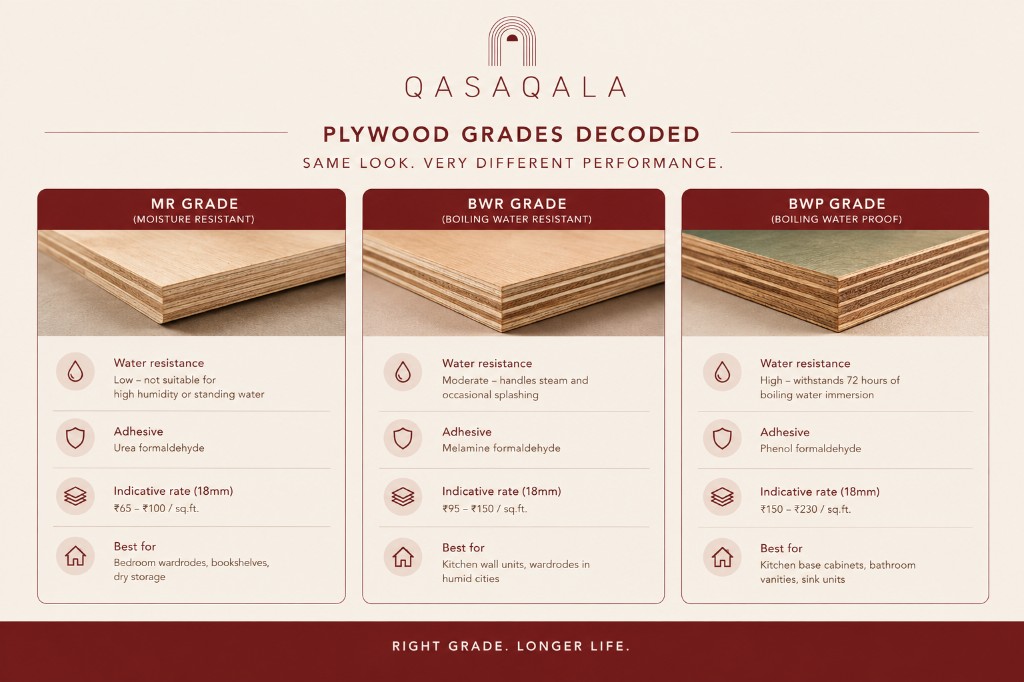
Indicative 2026 tier-1 metro rates (18mm, per sq.ft.):
| Grade | Rate (₹/sq.ft.) | Where it belongs |
|---|---|---|
| MR | 65–100 | Bedroom wardrobes, bookshelves, dry storage |
| BWR | 95–150 | Kitchen wall units, wardrobes in humid cities |
| BWP / Marine | 150–230 | Kitchen base cabinets, bathroom vanities, sink units |
Tier 2 city rates typically run 10 to 20 percent lower than these estimates. Prices above exclude 18% GST, which most dealers quote separately.
Plywood vs. Particle Board vs. MDF vs. HDHMR
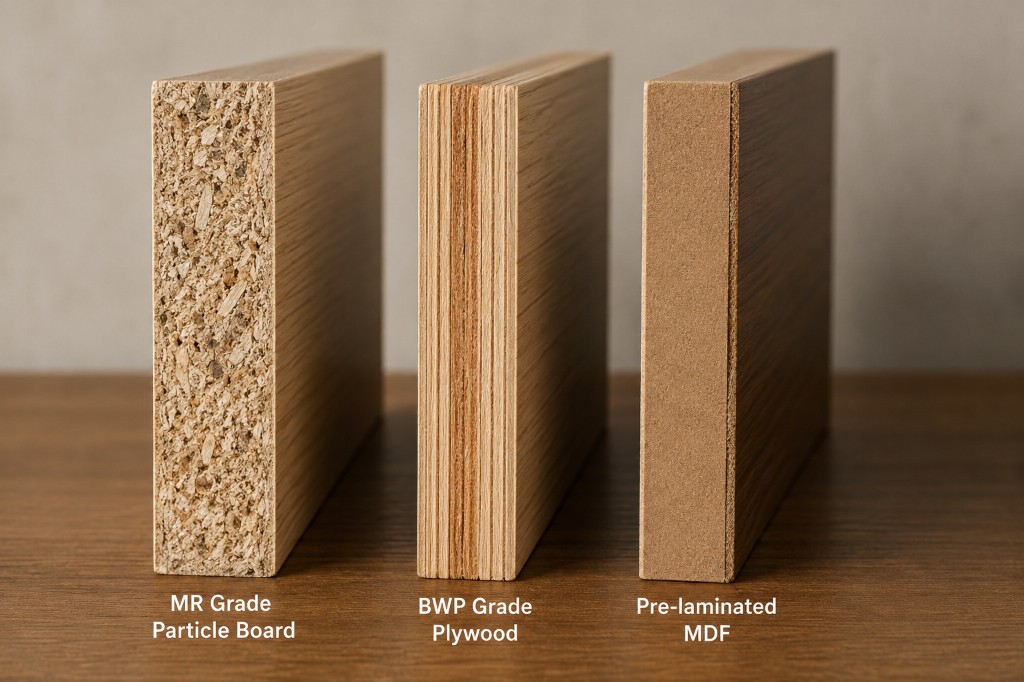
These four aren't tiers of the same material, they're different materials with different physics, and mixing them up is how buyers end up paying plywood prices for particle board performance, or the reverse.
- Plywood: thin wood veneers cross-layered and glued under pressure. The cross-layering is what gives it strength. A standard 18mm BWR sheet can carry meaningfully more load per linear meter than the same thickness in particle board without sagging. Best for load-bearing carcasses, shelves, and anything that takes daily weight or stress.
- Particle board: wood particles and resin compressed into a sheet. It's the most affordable option and machines cleanly, but it has the weakest moisture tolerance of the four. Without an MR-rated variant, it can swell and delaminate fast if it gets wet, and screws don't hold in it as well as in ply.
- MDF (Medium Density Fibreboard): fine wood fibres bonded under heat and pressure. Denser and smoother than particle board, which is why it takes paint and PU finishes beautifully, but plain MDF still swells noticeably without a moisture-resistant grade.
- HDHMR (High Density High Moisture Resistant): a denser, resin-treated fibreboard cousin of MDF, built specifically for Indian humidity. It cuts precisely on CNC machines, which is why it's become the default for shutter profiles and routed cabinet doors, and it resists swelling far better than standard MDF.
Worth remembering
HDHMR isn't "premium MDF," it's a different sheet built for a different job. Don't let a quote substitute one for the other without telling you.
Indicative 2026 tier-1 metro rates (18mm, per sq.ft.):
| Material | Rate (₹/sq.ft.) | Best suited for |
|---|---|---|
| Particle board (plain) | 28–45 | Budget wardrobe backs, non-visible panels |
| Particle board (MR) | 38–58 | Budget wardrobe carcasses in dry rooms |
| MDF (plain) | 48–75 | Painted shutters, wall panelling |
| MDF (MR) | 65–95 | Shutters in kitchen-adjacent or humid areas |
| HDHMR | 100–160 | Kitchen and wardrobe shutter profiles, routed doors |
Matching Board to Room: A Practical Cheat Sheet
| Zone | Recommended board | Why |
|---|---|---|
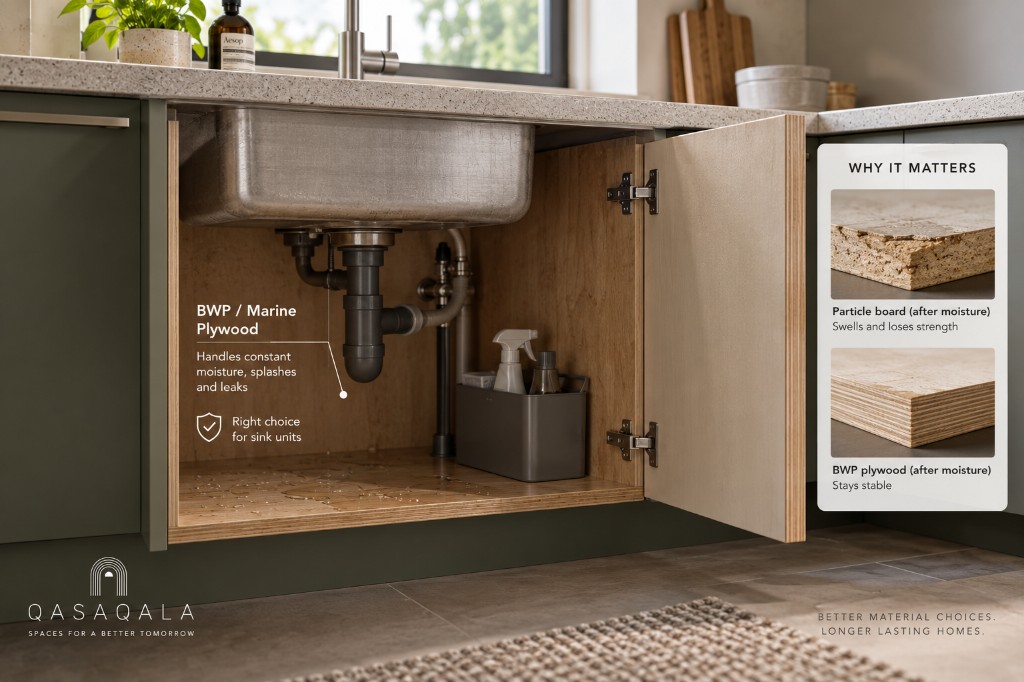
| Kitchen base cabinets, sink unit | BWP / Marine plywood | Constant splash and floor moisture |
| Kitchen wall cabinets | BWR plywood | Steam exposure, less direct water |
| Kitchen shutters | HDHMR or laminate-faced ply | Precision cuts, wipeable finish |
| Wardrobe carcass (dry bedroom) | MR plywood or MR particle board | Cost-effective, low humidity risk |
| Wardrobe carcass (coastal or ground-floor humid) | BWR plywood | Meaningfully better humidity tolerance |
| Wardrobe shutters | HDHMR or MDF | Smooth finish, holds paint/laminate well |
| Bathroom vanity | BWP / Marine plywood | Daily water spray, near-constant humidity |
| TV unit, bookshelf, study table | MR plywood or plain MDF | Dry, low load-bearing zones |
One clarification: premium-tier wardrobe packages sometimes spec BWP plywood across every carcass, dry bedrooms included. That's a legitimate durability upgrade some buyers choose to pay for, not a requirement the room itself demands. Know it's an upsell, not a fix, before you pay the premium for it.
Where to upgrade
You don't need marine ply everywhere. The single highest-value place to spend on a board upgrade is wherever water actually collects: the sink base, the dishwasher unit, the bathroom vanity, not the shutter over your bedroom bookshelf.
What's Actually Inside Your BOQ's Board Rate
If you've read our BOQ guide, you've seen modular kitchen shutters quoted around Rs 1,500 per sq.ft. and wardrobes around Rs 1,400 per sq.ft. as flat, all-in rates. Those numbers bundle four things together, and the board itself is usually the smallest slice.
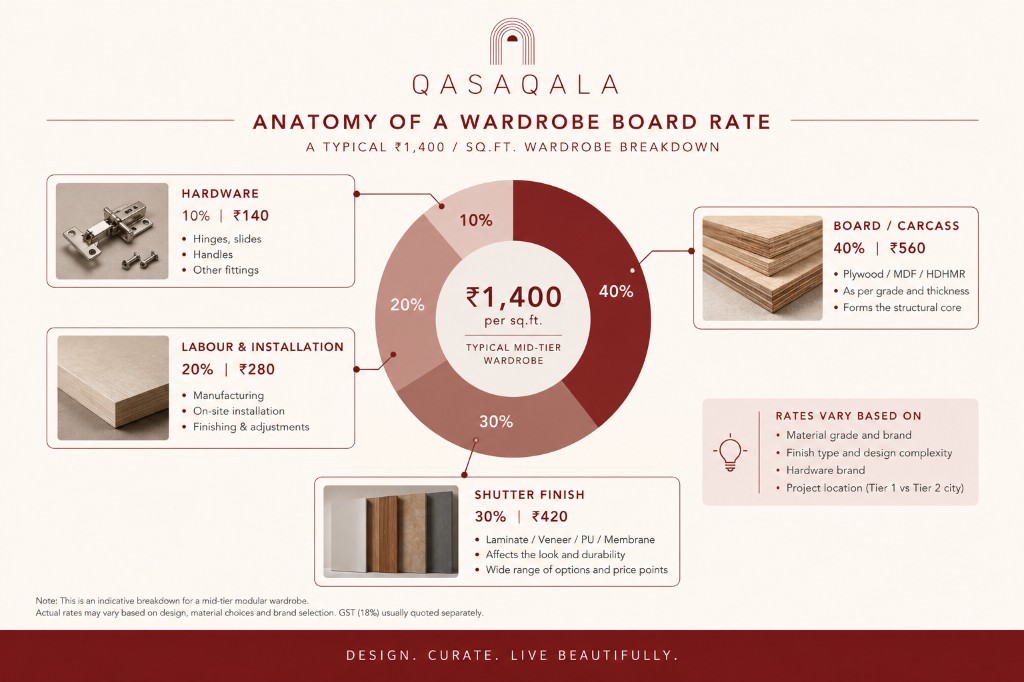
Rough breakdown of a Rs 1,400/sq.ft. wardrobe rate:
| Component | Approx. share | Approx. ₹/sq.ft. |
|---|---|---|
| Carcass + shutter board | 25–30% | 350–420 |
| Shutter finish (laminate/veneer/PU) | 25–30% | 350–420 |
| Hardware (hinges, channels, handles) | 15–20% | 210–280 |
| Fabrication and installation labor | 25–30% | 350–420 |
This is why two contractors quoting the identical Rs 1,400 per sq.ft. can hand over very different wardrobes. One might be spending 30 percent of that rate on BWR plywood and branded hinges, the other 20 percent on unbranded MR particle board with unnamed hardware, pocketing the difference in the finish you can already see. Ask for the board grade and brand as a separate line, not folded into a single blended rate.
Red Flags When a Contractor Talks Boards
- "18mm plywood" quoted with no grade (MR, BWR, BWP) or brand named anywhere in the estimate.
- The same per sq.ft. rate quoted whether you choose MR or BWP, when the material cost difference alone should move the price.
- No ISI stamp or brand embossing visible on the actual board sample shown to you at the factory or site visit.
- "Branded MDF" mentioned without confirming whether it's the plain or MR-rated version. This single word changes the price and the lifespan.
- BWP marine ply proposed for every cabinet in the house, including dry bedroom wardrobes. An unnecessary upsell dressed up as diligence.
- The board sample shown during sales conversations doesn't match what's delivered on installation day. Ask to see the brand stamp again before shutters go up.
The Bottom Line
You will never see the board once your interior is finished, and that's exactly why it deserves ten minutes of attention before you sign anything. Three questions settle almost every board-related dispute before it starts: what grade, what brand, and can I see the sample with the stamp on it. Ask them for every cabinet and wardrobe in your BOQ, not just the kitchen, and you'll have already avoided the most expensive mistake buyers make in Indian interiors: paying for a marine-grade quote and receiving a monsoon-season problem.
See it in your actual room
Upload your floor plan and see any flooring type rendered in your own space - before ordering a single tile.
Try QasaQala free