
The bathroom is the smallest room in most Indian homes and the one where a mistake costs the most to fix. Get the tile colour wrong in the living room and you live with it. Get the waterproofing wrong in the bathroom and you're breaking tiles open eighteen months later, sometimes into your downstairs neighbour's ceiling. Yet it's also the room where buyers spend the least time before signing off, because sanitaryware and fittings feel like a quick showroom decision compared to a full kitchen or wardrobe.
This guide covers the four things that actually decide whether your bathroom is a five-year problem or a fifteen-year asset: waterproofing, layout, sanitaryware, and fittings, in that order of importance, not the order most quotes present them in.
Waterproofing: The One Line You Should Never Cut
Waterproofing is the least visible line item in a bathroom BOQ and the most expensive to get wrong after the fact, because fixing a leak once tiles are down means breaking tiles, sometimes breaking into the slab, to get at the membrane underneath.
Most bathroom leaks don't come from where people expect. The floor slab itself is rarely the problem. The failure point is almost always the joint where the floor meets the wall, the corner that gets missed when a coat is rolled on in a hurry.
Close to 70 percent of bathroom leaks start at the floor-wall joint, not the floor itself, which is exactly the seam that gets skipped when waterproofing is rushed or bundled into a vague lump sum.
Indicative 2026 tier-1 metro rates:
| Waterproofing scope | Rate | What it covers |
|---|---|---|
| Floor coating only | ₹40–90/sq.ft. | Basic chemical coating on the floor slab |
| Floor + wall-joint treatment | ₹60–120/sq.ft. | Reinforced tape at the joint, plus coating, the combination that actually prevents most leaks |
| Sunken slab + wet zone system | ₹90–150/sq.ft. | Full membrane system for a sunken floor and shower area, the most thorough option |
Tier 2 city rates typically run 10 to 20 percent lower. Prices above exclude 18% GST and cover materials plus application labour.
On waterproofing warranties
Ask for a written warranty on waterproofing, typically 5 to 10 years from an established applicator. A verbal assurance that "it's been done properly" is not a specification, and it's not something you can hold anyone to later.
Wet Zone vs. Dry Zone: Getting the Layout Right
Every functional Indian bathroom separates into two zones, whether or not the layout makes that separation obvious. The wet zone is where water is meant to fall, the shower or bucket-bath area. The dry zone is everywhere else, the WC and wash basin, where water should never collect.
- Wet zone: minimum 900mm x 900mm, comfortable at 900mm x 1200mm, with the floor sloped at roughly 1:50 toward the drain so water doesn't pool.
- Dry zone: floor sloped more gently, around 1:100, toward a smaller drain, with at least 750-900mm of clearance between the partition and the nearest fixture so the space is usable.
- Separation: a glass partition (1800-2000mm tall, 8-10mm toughened glass) is the cleanest option and keeps the dry zone genuinely dry. A dwarf wall with a glass topper is the more budget-friendly version of the same idea. A shower curtain is the cheapest option and the least effective, water still migrates past it over time.
- Ventilation: an exhaust fan is not optional in an Indian bathroom, most of which have no operable window or a small one. A ducted exhaust clears moisture that would otherwise sit in the wet zone and slowly work against your waterproofing.
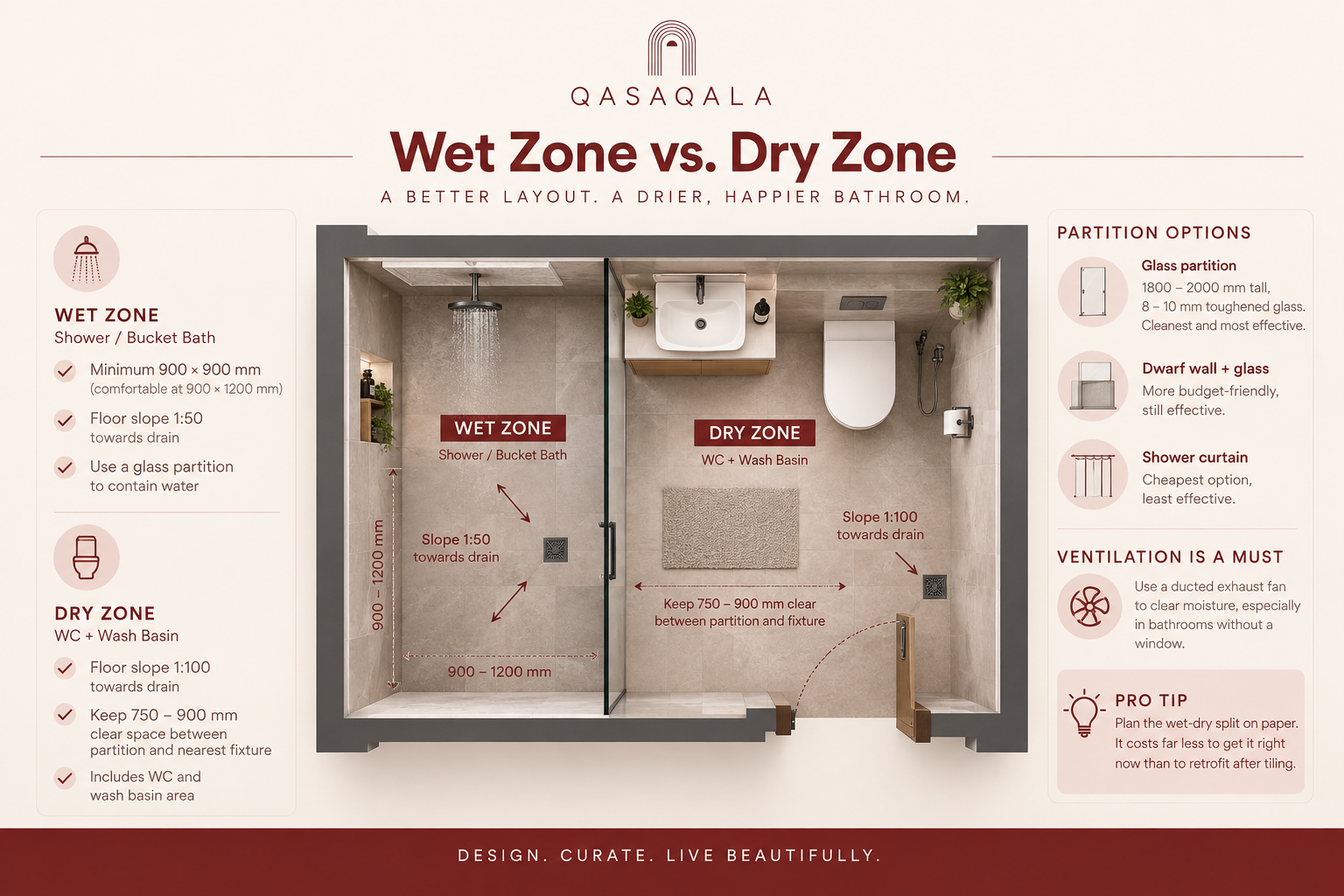
One clarification worth making up front: the wet-dry split is a layout decision, not a fittings upgrade, and it costs far less to plan correctly on paper than to retrofit after tiling.
Sanitaryware Tiers: EWC and Wash Basins
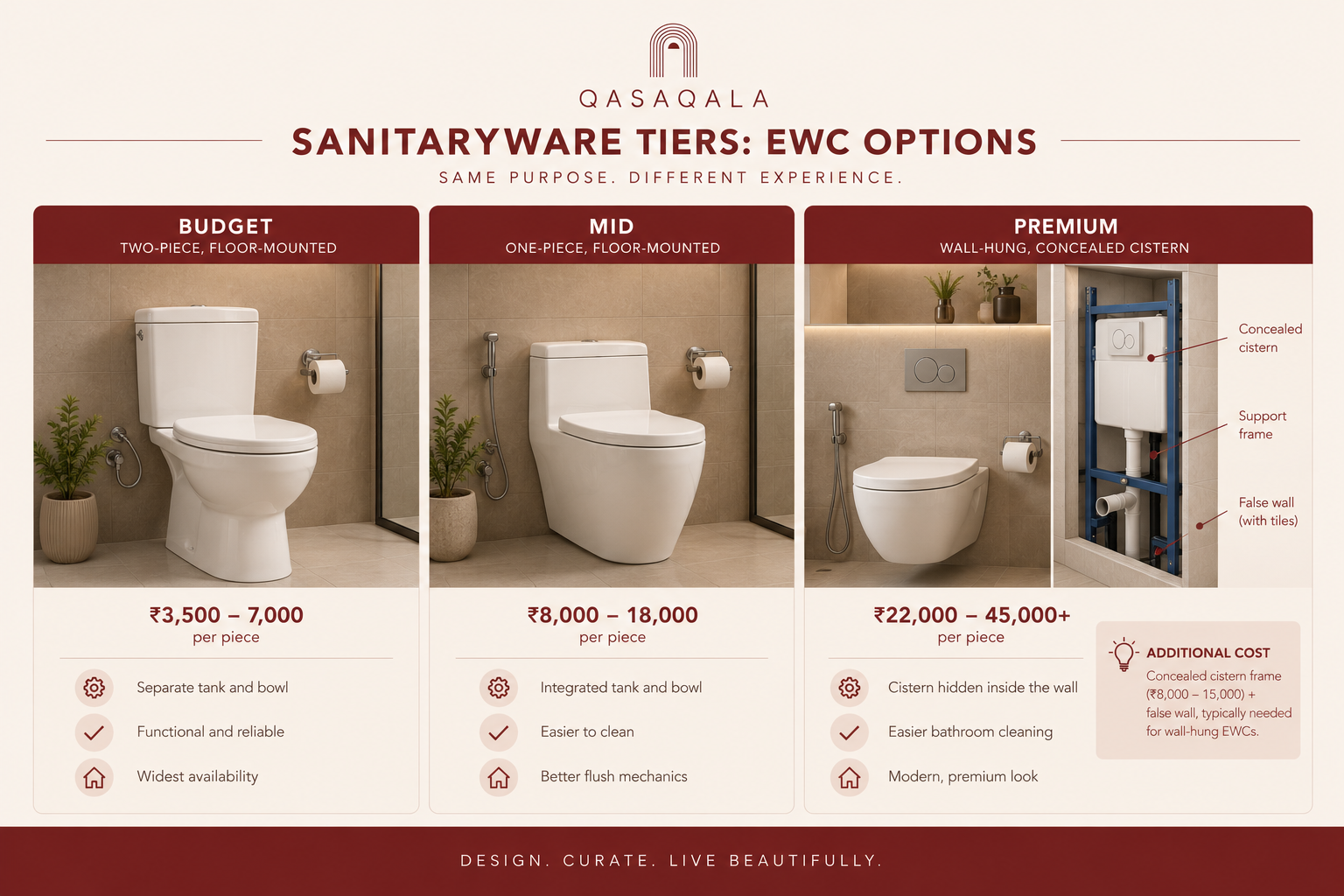
The EWC (European Water Closet) is the single sanitaryware purchase most buyers spend the most time comparing, and the three formats map cleanly onto a budget/mid/premium ladder.
| Tier | Format | Rate (per piece) | What you're paying for |
|---|---|---|---|
| Budget | Two-piece, floor-mounted | ₹3,500–7,000 | Separate tank and bowl, functional, widest availability |
| Mid | One-piece, floor-mounted | ₹8,000–18,000 | Integrated tank and bowl, easier to clean, better flush mechanics |
| Premium | Wall-hung, concealed cistern | ₹22,000–45,000+ | Cistern hidden inside the wall, easier bathroom cleaning, needs a concealed cistern frame as a separate cost |
On wall-hung EWCs
Wall-hung EWCs need a concealed cistern frame, typically ₹8,000-15,000 on top of the fixture price, plus a false wall to house it. If a quote shows a wall-hung EWC at a price that looks close to a one-piece floor-mounted unit, the frame usually isn't included yet.
Wash basins follow a similar budget-to-premium range, from ₹1,500-4,000 for a basic pedestal basin to ₹8,000-25,000+ for a designer counter-top basin, and the counter or vanity it sits on is a separate cost again, typically in BWP-grade plywood as covered in our board materials guide, since that's the one cabinet in the house that sits in near-constant humidity.
CP Fittings: Where the Money Actually Goes
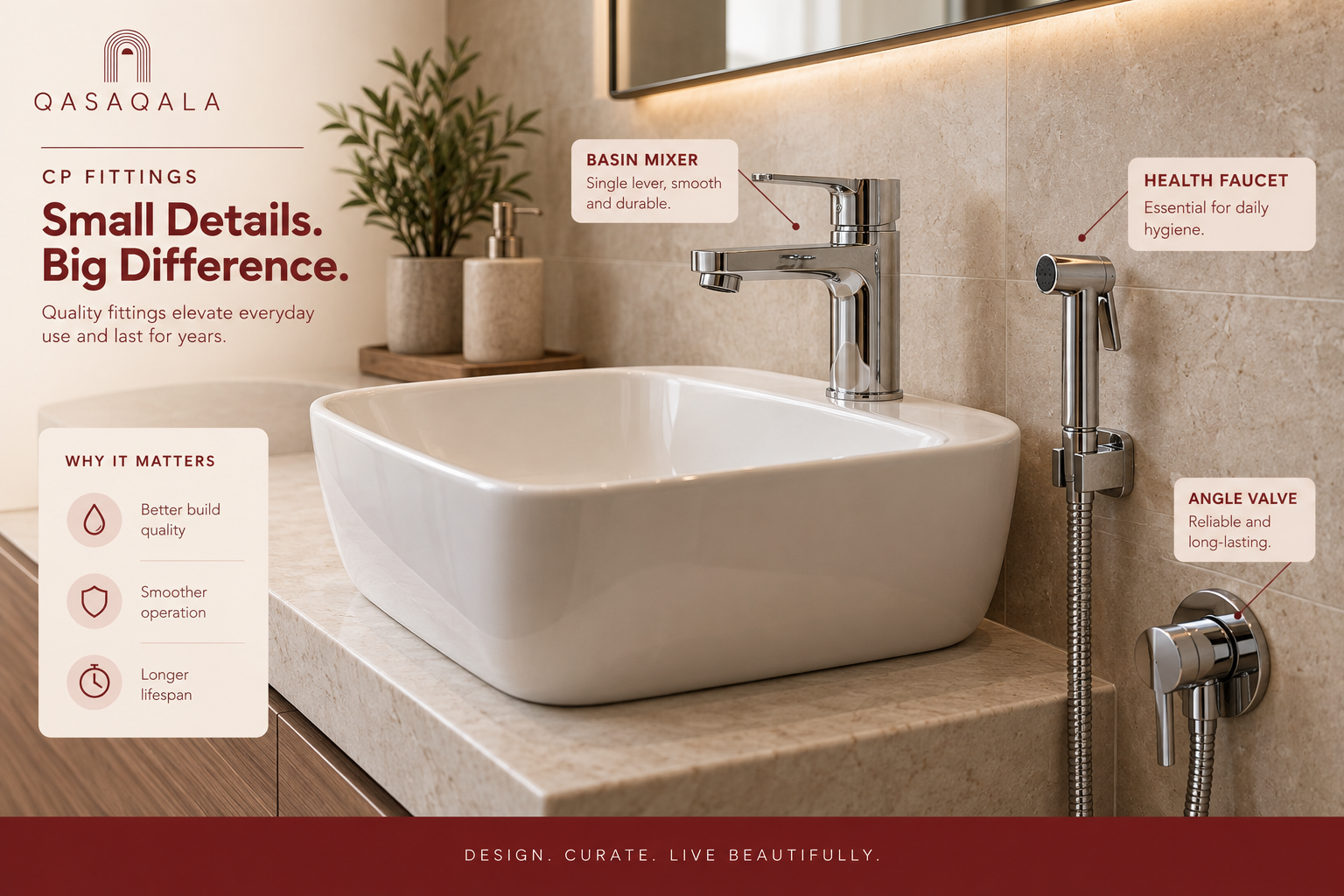
CP (chrome-plated) fittings, taps, shower sets, and the health faucet, are where bathroom budgets quietly balloon, because the same basic function (water comes out of a tap) spans an enormous price range depending on brand and finish.
| Tier | Basin mixer | Wall mixer / shower diverter | Health faucet | Full-set indicative total |
|---|---|---|---|---|
| Budget | ₹1,500–3,500 | ₹4,000–7,000 | ₹800–1,500 | ₹6,000–12,000 |
| Mid | ₹3,500–6,000 | ₹7,000–15,000 | ₹1,200–2,000 | ₹15,000–28,000 |
| Premium | ₹6,000–8,000+ | ₹15,000–50,000+ | ₹2,000–3,000+ | ₹35,000–70,000+ |
Installation labour for fittings runs ₹200-500 per unit, or ₹6,000-15,000 for a full bathroom setup including sealing and testing, per the same tiering.
A basin mixer and a wall mixer that look nearly identical on a showroom wall can sit ₹10,000 apart once you account for the internal cartridge quality, and that difference is exactly what determines whether the tap still turns smoothly in three years or starts dripping in one.
What a Bathroom Actually Costs: Budget / Mid / Premium
Here's a worked example for a fairly standard 40 sq.ft. attached bathroom (roughly 5.5 feet by 7.5 feet), bringing together tiling, waterproofing, sanitaryware, fittings, partition, and ventilation into one number per tier.
| Component | Budget | Mid | Premium |
|---|---|---|---|
| Tiling (floor + full-height walls) | ₹11,200–14,000 | ₹15,200–19,200 | ₹22,000–30,000 |
| Waterproofing | ₹2,400–3,600 | ₹3,600–4,800 | ₹4,800–7,200 |
| Sanitaryware (EWC + basin) | ₹6,000–10,000 | ₹14,000–25,000 | ₹35,000–70,000 |
| CP fittings (full set) | ₹6,000–10,000 | ₹15,000–28,000 | ₹35,000–70,000 |
| Wet-dry partition | ₹3,000–8,000 | ₹12,000–20,000 | ₹25,000–45,000 |
| Exhaust and ventilation | ₹1,500–2,500 | ₹2,500–4,500 | ₹4,500–8,000 |
| Installation labour | ₹5,000–8,000 | ₹8,000–12,000 | ₹12,000–18,000 |
| Total (indicative) | ₹35,000–56,000 | ₹70,000–1,14,000 | ₹1,40,000–2,48,000+ |
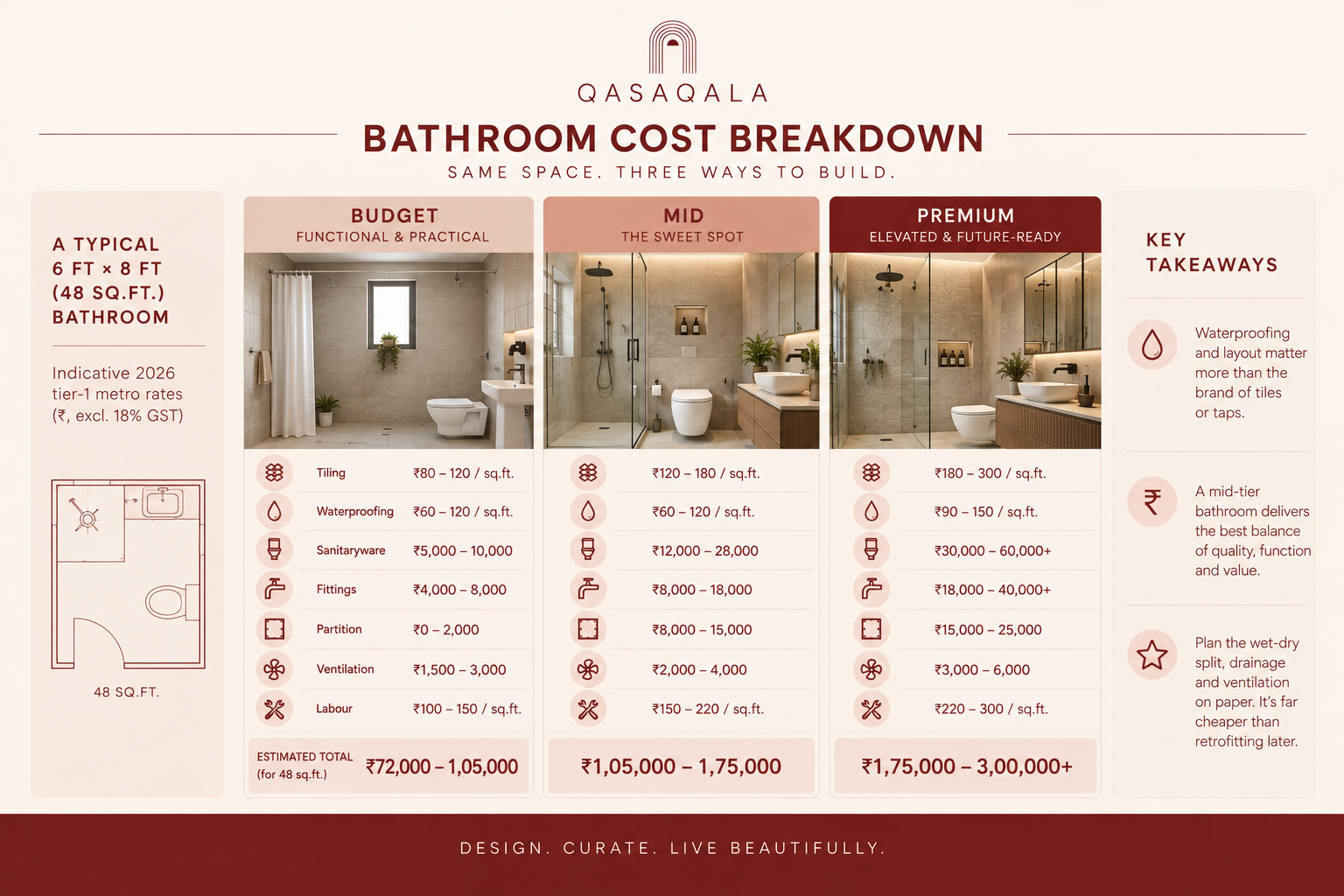
Tier 2 city rates run 10 to 20 percent lower across the board. If you've read our BOQ guide, you'll recognise "plumbing rework" as the vague lump sum that quotes often use to bundle waterproofing and fitting labour together, while sanitaryware and tiles get priced separately elsewhere. This table is what that lump sum should actually be itemising.
Red Flags When a Contractor Talks Bathrooms
- Waterproofing appears as an unspecified lump sum with no scope (floor only, or floor plus joint) and no warranty period mentioned.
- The floor-wall joint isn't called out separately, given it's the single most common leak point.
- Anti-skid rating isn't confirmed for the wet-zone floor tile, a genuinely slippery bathroom floor is a safety issue, not a style choice.
- A wall-hung EWC is quoted without a separate line for the concealed cistern frame and false wall.
- CP fittings are bundled as one unspecified number instead of basin mixer, wall mixer, and health faucet priced individually.
- No exhaust fan or ventilation line appears in the estimate at all.
- No slope or drainage check is mentioned before tiling begins, this is a five-minute test that catches a problem while it's still cheap to fix.
The Bottom Line
A bathroom's visible choices, the tile, the fittings, the EWC, are also its cheapest to fix if you don't love them later. Its invisible choice, waterproofing, is the one that's expensive, disruptive, and sometimes not even yours alone to fix if it fails into a neighbour's ceiling below. Get a written waterproofing warranty, confirm the floor-wall joint is treated and not just the floor, and get your wet and dry zones planned on paper before anyone starts tiling. Everything else in this room is a preference. That one is a requirement.
See it in your actual room
Upload your floor plan and see any flooring type rendered in your own space - before ordering a single tile.
Try QasaQala free